
Il chiostro di fondazione quattrocentesca, venne modificato all’inizio del XVI secolo, nel XVII, infine all’inizio degli ’30 del XX secolo.
La ristrutturazione del XVII secolo arricchì il chiostro di un ciclo pittorico, presumibilmente composto da 35 affreschi realizzati nelle lunette del porticato e narranti la vita e i miracoli di Sant’Antonio.
Incerta è l’attribuzione dell’opera, secondo alcune fonti si tratterebbe di Bernardo e Bernardino Muttoni. In merito alla datazione dell’opera possiamo fare riferimento alle due date che compaiono nelle pitture: il 1660 nell’ultima lunetta del ciclo dedicata all’Immacolata Concezione (n.28), e il 1705 leggibile sopra la porta d’ingresso alla chiesa (lunetta n.17).
Tra il 1929 e il 1932 a seguito della demolizione e ricostruzione dell’ala del convento, sono plausibilmente andati perduti 7 dei 35 affreschi che componevano il ciclo narrativo.
The cloister dedicated to Saint Anthony
The cloister estabilished in the 15th century was altered in the early 16th century, in the 17th century, finnaly in the early 1930s.
The 17th-century renovation enriched the cloister with a pictorial cycle, presumably comprising 35 frescoes painted in the lunettes of the portico and narrating the life and miracles of Saint Anthony.
The attribution of the work is uncertain; according to some sources, it is the work of Bernardo and Bernardino Muttoni. As regards the dating of the work, we can refer to the two dates appearing in the paintings: 1660 in the final lunette of the cycle, dedicated to the Immaculate Conception, and 1705, visible above the entrance door to the church.
Between 1929 and 1932, following the demolition and reconstruction of the wing of the convent, it is likely that 7 of the 35 frescoes that made up the narrative cycle were lost.
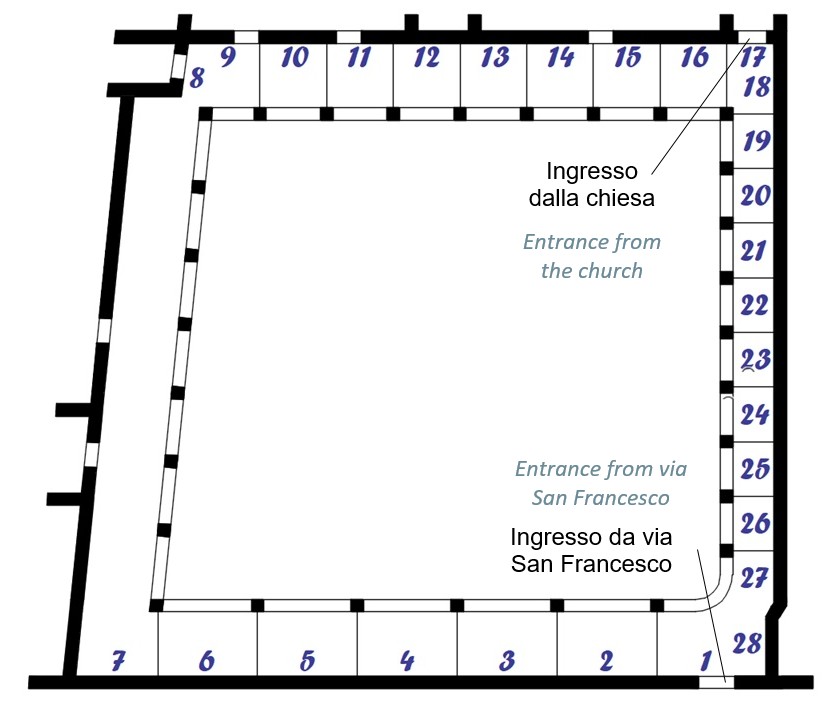
Fig. 1
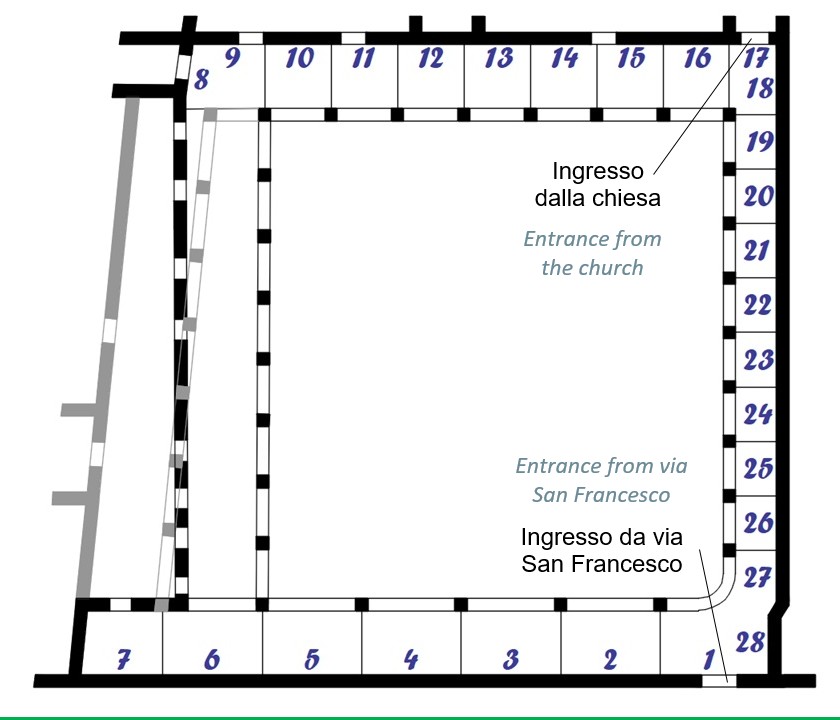
Fig. 2
Lo schema planimetrico mostra nella Figura 1 com’era il chiostro prima del rifacimento novecentesco dell’ala obliqua e nella Figura 2 mostra com’è oggi. I numeri indicano le lunette affrescate
The layout in Figure 1 shows what the cloister looked like before the 20th-century renovation of the sloping wing, and Figure 2 shows what it looks like today. The numbers indicate the frescoed lunettes
La ristrutturazione novecentesca, comportò un ampliamento edilizio che ridusse l’area verde interna, rendendo paralleli i due opposti porticati. A seguito di questo intervento la lunetta n.7 si viene a trovare oggi “esclusa” dal percorso porticato vero proprio.
Il ciclo pittorico tra il 2004 e il 2010 ha subito un importante intervento di restauro ad opera dell’Istituto Veneto per i Beni Culturali che ci permette oggi di ammirare gli affreschi in tutto il loro splendore.
Il ciclo, attualmente composto di 28 lunette, rappresenta una rilevante testimonianza della diffusione del culto antoniano in territorio veneto nel corso dei secoli e conferma l’insostituibile funzione didattica espletata dalle arti figurative.
Il percorso con cui vengono presentati gli affreschi è in senso orario e inizia dall’ìngresso al chiostro da via san Francesco.
The 20th-century renovation of the wing of the cloister, involved an extension that reduced the internal green space, bringing the two opposing porticoes into alignment.
As a result of this work, the lunette n.7 now finds itself ‘excluded’ from the cloister’s actual porticoed walkway.
The series of paintings, created between 2004 and 2010, underwent a major restoration project carried out by the Istituto Veneto per i Beni Culturali, which now allows us to admire the frescoes in all their splendour.
The cycle, currently comprising 28 lunettes, stands as a significant testament to the spread of the cult of St Anthony throughout the Veneto region over the centuries and confirms the irreplaceable educational role played by the visual arts.
The route along which the frescoes are presented follows a clockwise direction and begins at the entrance to the cloister from Via San Francesco.
1. Lunetta della porta d’ingresso.
Lunette of the entrance door.
È andata perduta a causa dell’apertura di un portale più grande. Ne rimane solo un frammento sul lato sinistro, che non è riconoscibile.
It has been lost because of the opening of a bigger portal. Only a fragment survives on the left‐hand side, which is not recognizable.
2. Antonio diventa frate francescano.
Anthony becomes a Franciscan friar.
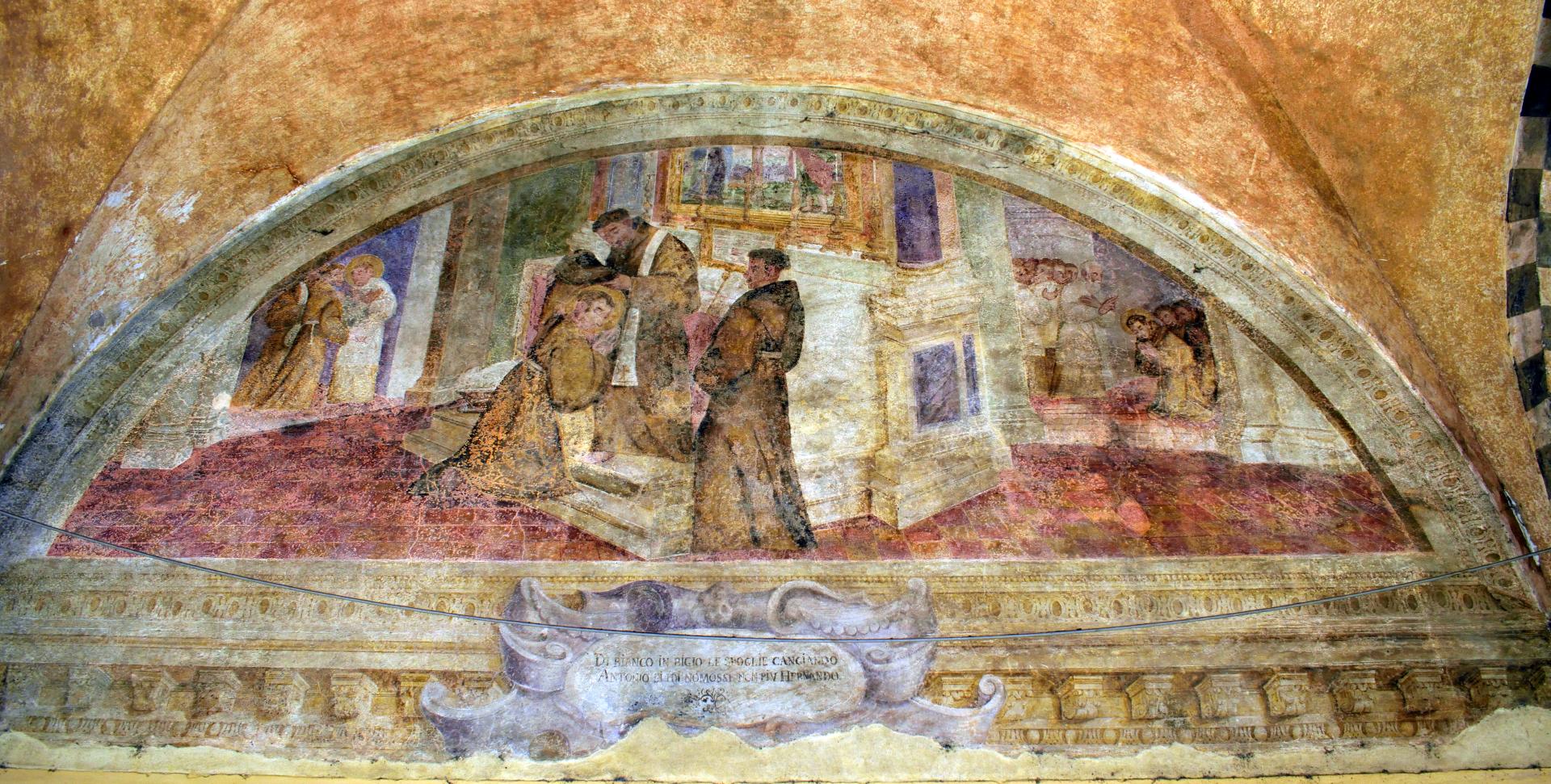
Il cartiglio recita: «DI BIANCO IN BIGIO LE SPOGLIE CANGIANDO / ANTONIO DI POI NOMOSSI NON PIU HERNANDO».
The scroll says: «DI BIANCO IN BIGIO LE SPOGLIE CANGIANDO / ANTONIO DI POI NOMOSSI NON PIU HERNANDO».
3. Antonio viene scaraventato dalla tempesta in Sicilia mentre tenta di raggiungere il Marocco per evangelizzare.
Anthony is thrown by a storm to Sicily, while trying to get to Morocco to evangelize.
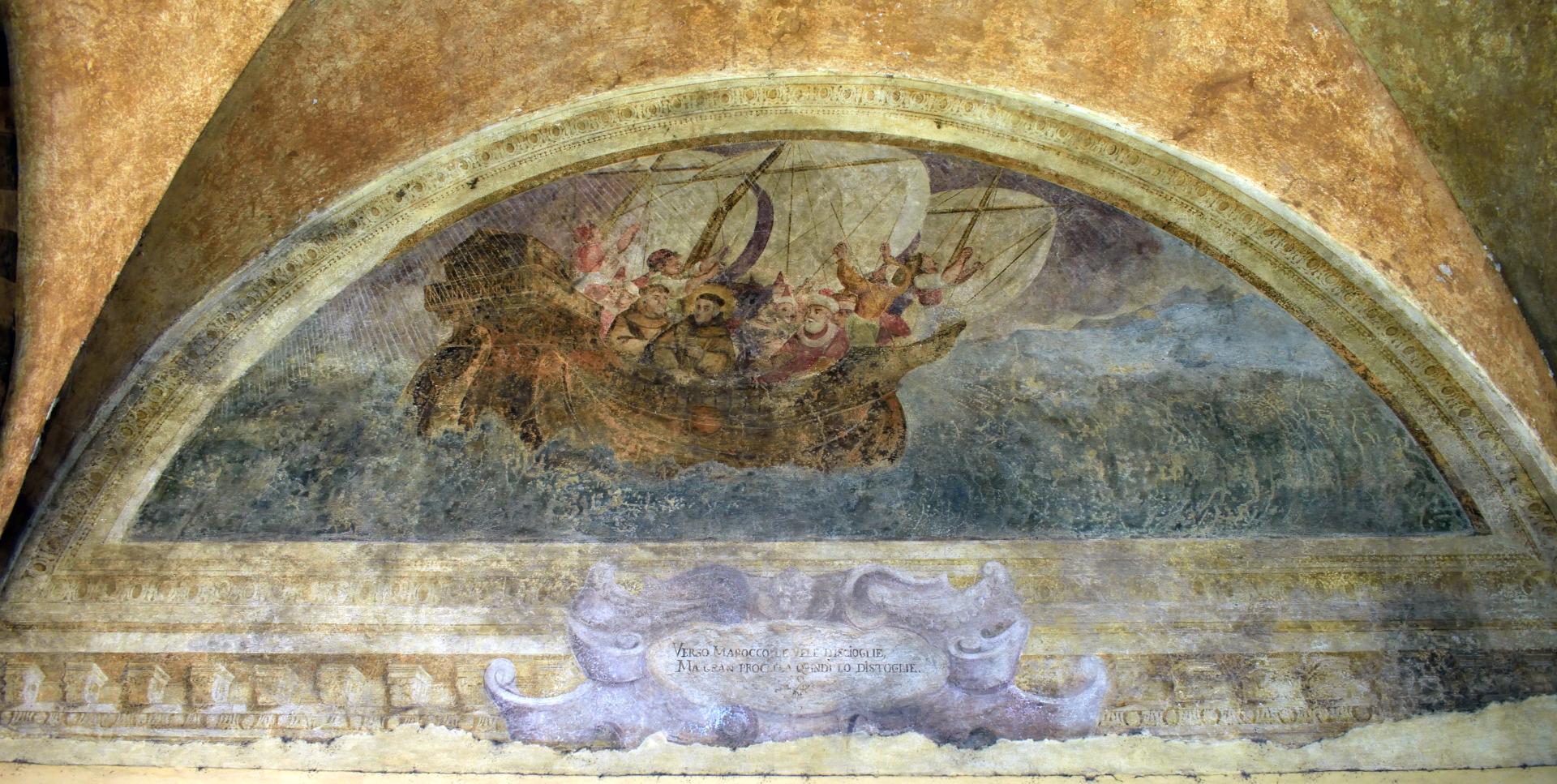
L’iscrizione dice: «VERSO IL MAROCCO LE VELE DISCIOGLIE / MA GRAN PROCELLA QUINDI LO DISTOGLIE». L’affresco ha una composizione molto efficace. Si nota il veliero affollato di persone di varia estrazione, tra le quali emerge Antonio aureolato intento a pregare con un compagno, mentre i marinari intorno ammainano le vele per far fronte alla tormenta.
The inscription says: «VERSO IL MAROCCO LE VELE DISCIOGLIE / MA GRAN PROCELLA QUINDI LO DISTOGLIE». The composition of the scene is very eflective. We can note the sailing ship, crowded with people from diflerent origins, including Anthony with a halo. He is praying with a mate, while the sailors around are hauling down the sails to face the storm.
4. Ritiro in preghiera di Antonio nella grotta di Limoges in Francia.
Anthony retires in prayer in the grotto of Limoges, France.
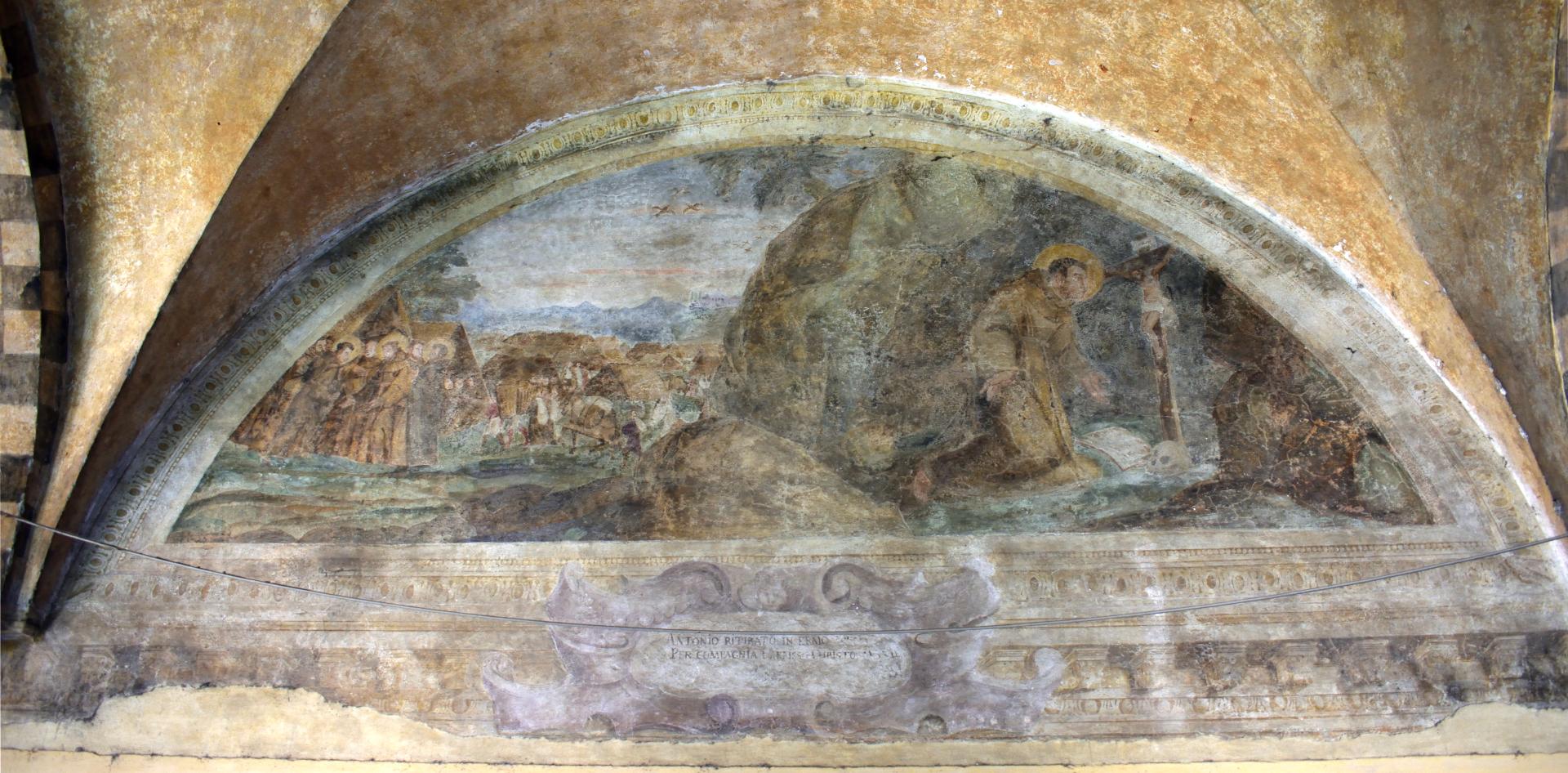
Nel cartiglio si può leggere: «ANTONIO RITIRATO IN ERMO […] / PER COMPAGNIA AFFISSO CHRISTO[…]». Si vede il Santo all’imbocco di una caverna che prega dinnanzi al Crocifisso.
In the cartouche we can read: «ANTONIO RITIRATO IN ERMO […] / PER COMPAGNIA AFFISSO CHRISTO […]». We can see the Saint in a cave while praying in front of the Crucifix.
5. Predica di Forlì.
Preaching of Forlì.
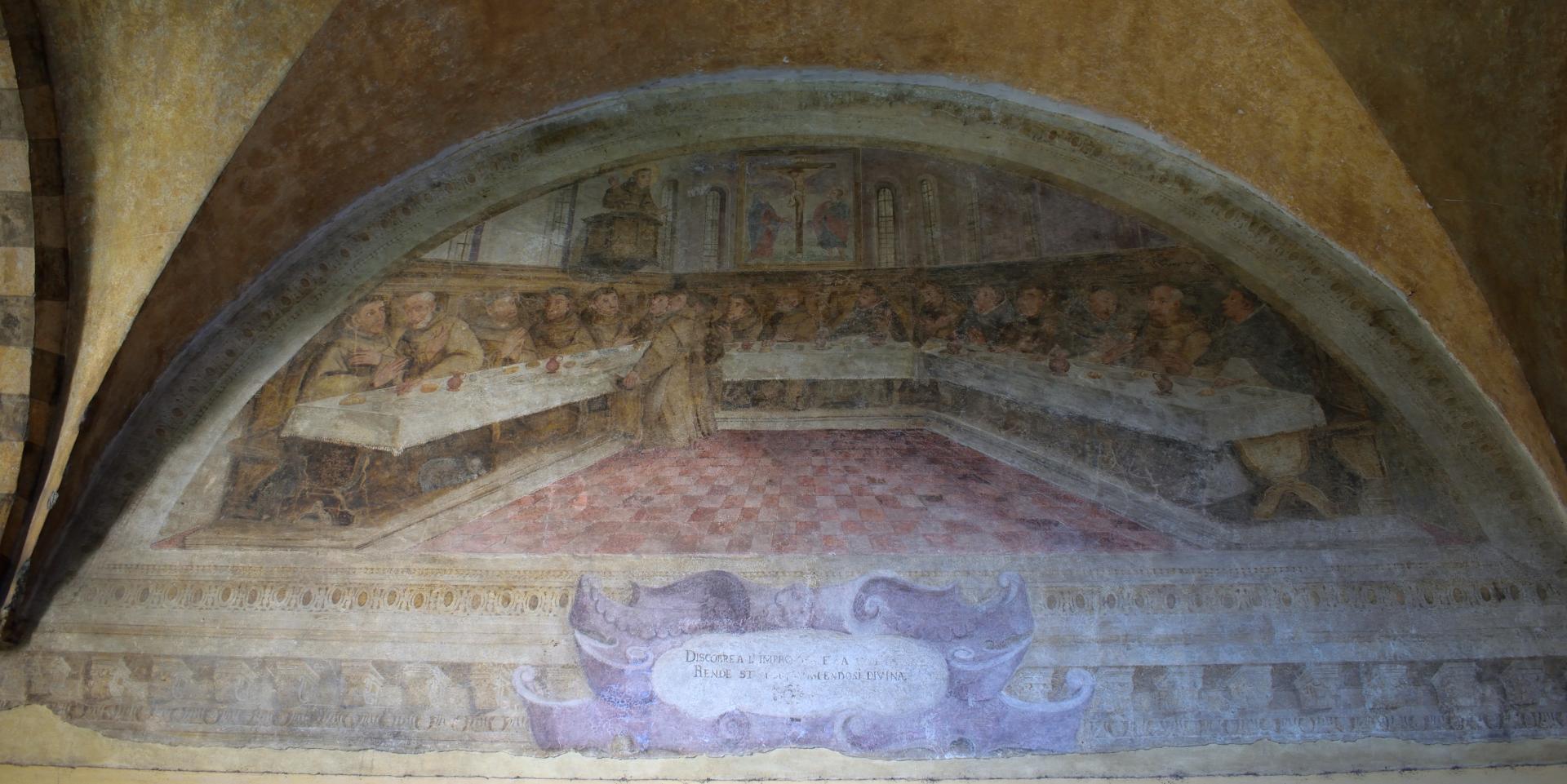
Nel cartiglio: «DISCORREA ALL’IMPROVVISO E […] / RENDE ST […] CENDOSI DIVINA». Dovendo pronunciare un discorso di fronte agli ordinandi francescani e domenicani (se ne vede almeno uno di questi ultimi sulla destra) ed essendosi tutti rifiutati di prendere la parola, Antonio comincia a predicare dal pulpito, rivelandosi grande oratore. (anno 1222)
In the cartouche: «DISCORREA ALL’IMPROVVISO E […] / RENDE ST […] CENDOSI DIVINA.» Having to give a speech in front of the ordained Franciscans and Dominicans (we can see at least one of the latter on the right) and having all refused to do so, Anthony began to preach from the pulpit, revealing himself as a great orator.
6. Antonio riceve la lettera da san Francesco che lo incarica di insegnare teologia.
Anthony receives a letter from Saint Francis, who instructs him to teach Theology.
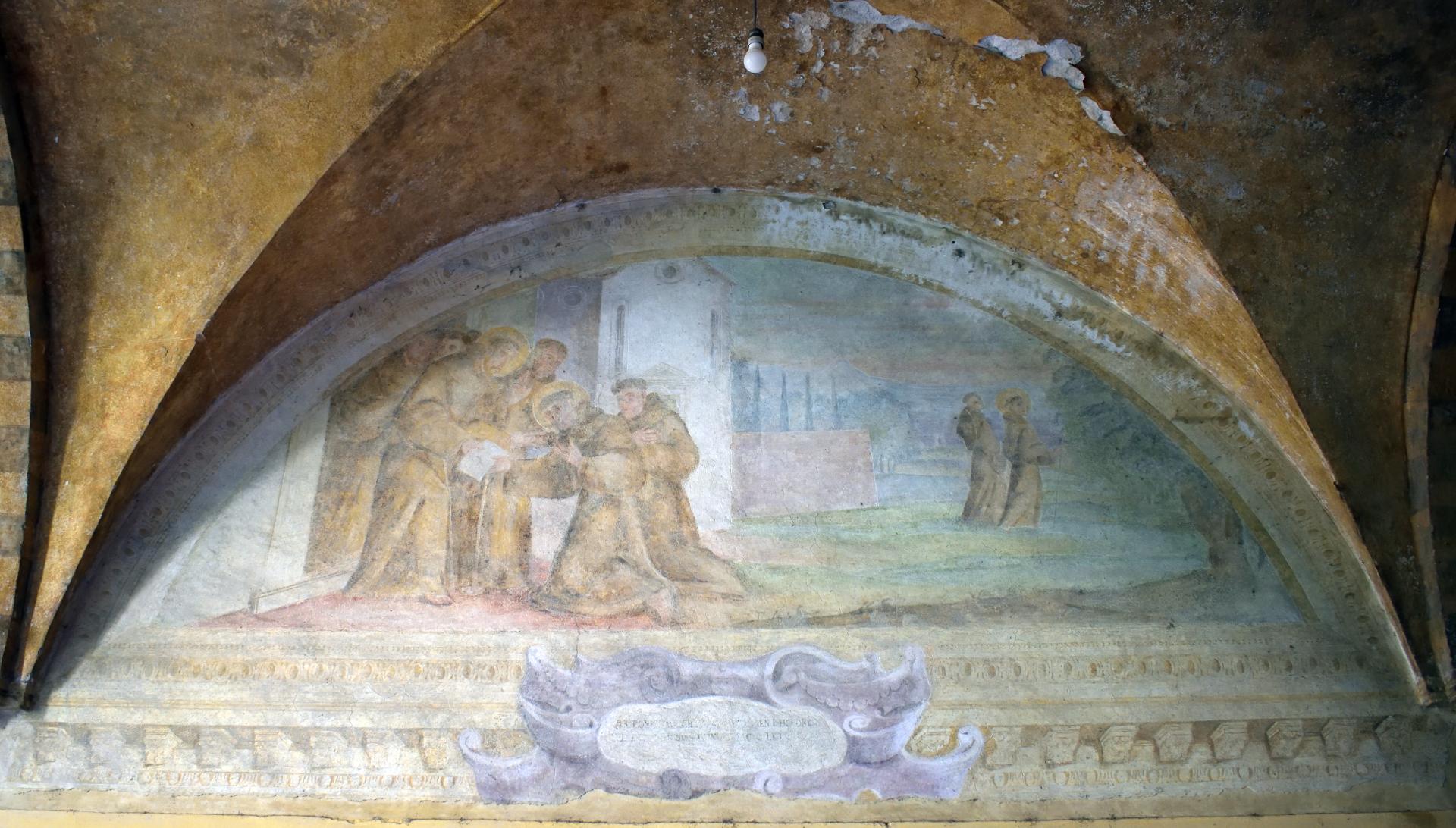
Purtroppo il cartiglio è quasi illeggibile: «ANTONIO […] EN HONORE / […] LEI». Dinnanzi a un’architettura assisiate, Antonio si inginocchia di fronte a Francesco, il quale gli porge la breve lettera con cui lo incarica di insegnare e predicare. Sulla destra, nello sfondo, si vede nuovamente Antonio mentre sia avvia in missione in compagnia di un fratello.
Unfortunately, the cartouche is almost illegible, «ANTONIO […] EN HONORE / […] LEI». In front of a church in Assisi, Anthony kneels before Francis, who hands him a brief letter that initiates him to teach and preach. On the right, in the background, once again we can see Anthony going on a mission with a brother.
7. Miracolo della grandine o predica di Bourges.
Miracle of the hail or Preaching of Bourges.
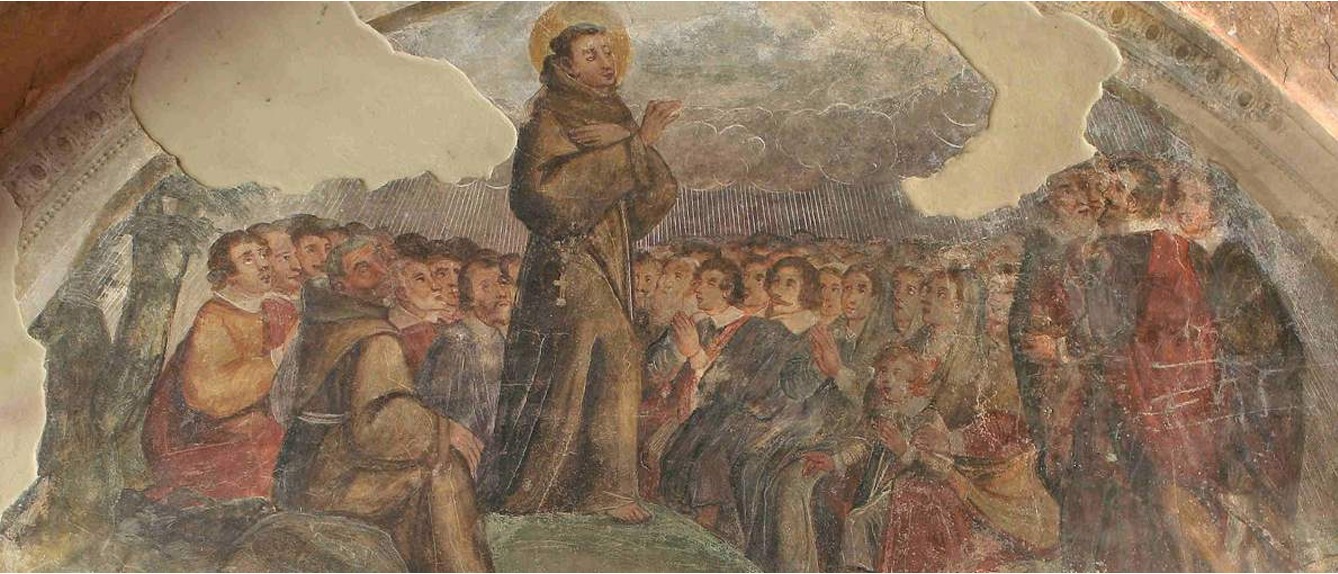
L’iscrizione recita: «GLOBI DI GELO INTORNO UN NEMBO SPANDE / NE TOCCA IL SANTO, OMERAVIGLIA GRANDE».
Antonio predica a una grande folla presso Bourges in Francia.
Il demonio per infastidire gli ascoltatori manda una terribile tempesta, che prontamente Antonio allontana per terminare il suo sermone, lasciando così incolume il suo pubblico.
Va notato che questa lunetta è forse la meglio conservata e meno abrasa dagli agenti atmosferici, trovandosi essa in un angolo molto riparato rispetto al resto delle pitture. Pur presentando alcune cadute dell’intonaco, la compattezza degli strati pittorici è tale da permetterci di apprezzare la qualità pittorica quasi come poteva essere originariamente, mentre nelle altre lunette essa ha perso materia e vivacità.
(anno 1226)
The inscription states: «GLOBI DI GELO INTORNO UN NEMBO SPANDE / NE TOCCA IL SANTO, O MERAVIGLIA GRANDE».
Anthony was in Bourges, France, and preached to a large crowd.
The devil, in order to annoy the listeners, sent a terrible storm, which promptly Antonio sent away to finish his sermon. The audience was left thus unharmed.
It should be noted that this lunette is perhaps the best preserved and least abraded from the weather elements, as it is located in a very sheltered corner if compared to the rest of the paintings. Though presenting some fallen plaster, the compactness of the paint layers is such that we can appreciate the quality of the painting almost as in its original conditions, while the other lunettes have lost matter and liveliness.
8. Sant’Antonio con il Bambino.
Saint Anthony and Child.
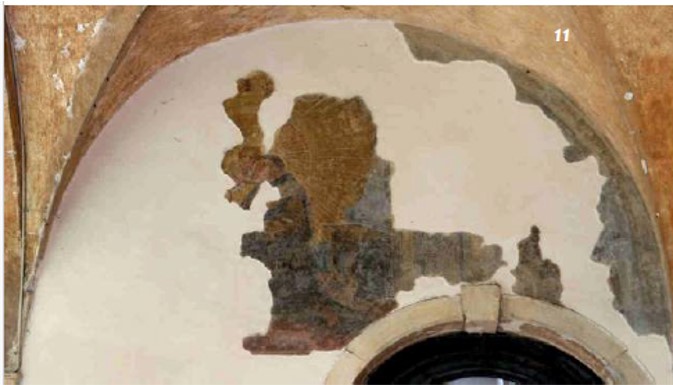
La lunetta è molto lacunosa, ma si è conservato un lacerto della parte sinistra in cui si vede Antonio con in braccio il bambinello. Non sopravvive il cartiglio.
This lunette is incomplete, but a left‐hand side fragment can still be seen, where Anthony is holding Baby Jesus. The cartouche has not survived.
9. Miracolo dei pesci.
Miracle of the fish.
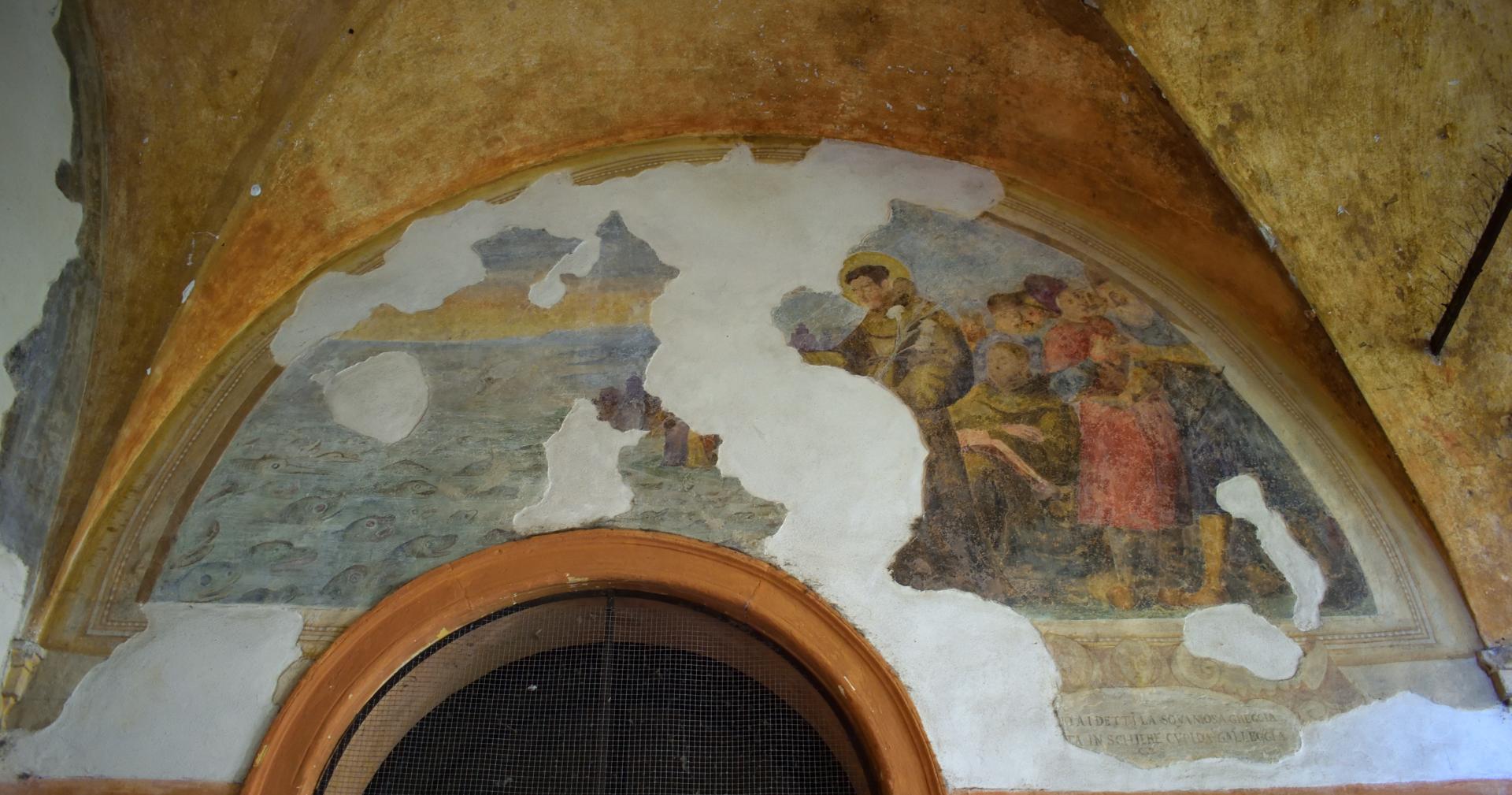
Antonio è intento a predicare presso Rimini e i pesci accorrono in gran numero per l’occasione, mentre gli uomini non lo ascoltano. La spiega dice: «[…] AI DETTI LA SQUAMOSA GRECCIA / […]TA IN SCHIERE CUPIDA GALLEGGIA».
Anthony is preaching in Rimini and the fish arrive in a large number for the occasion, while the people do not listen. The cartouche says: «[…] AI DETTI LA SQUAMOSA GRECCIA / […]TA IN SCHIERE CUPIDA GALLEGGIA».
10. Antonio incontra e ammonisce Ezzelino da Romano.
Anthony meets and warns Ezzelino da Romano.
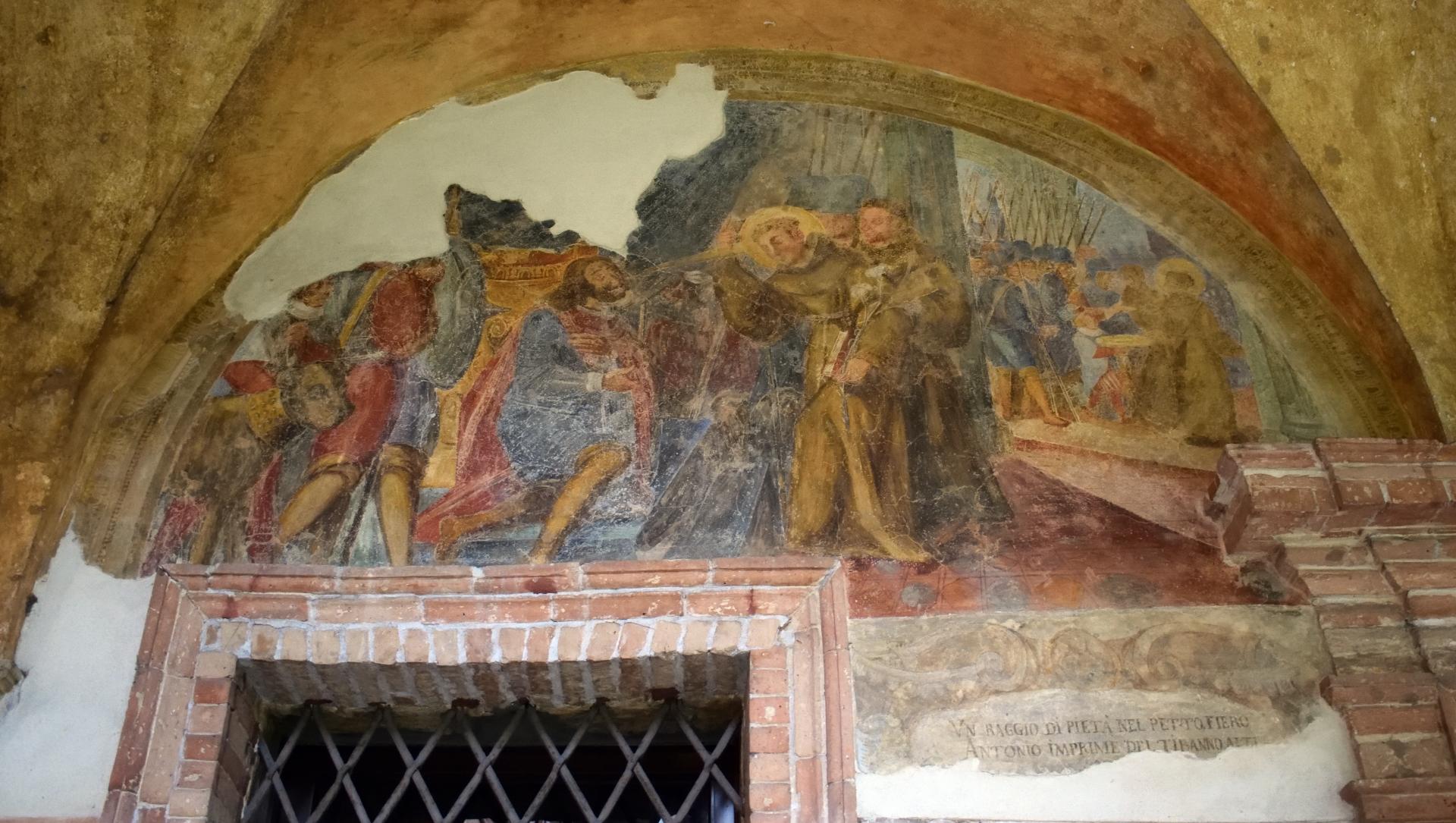
«UN RAGGIO DI PIETA’ NEL PETTO FIERO / ANTONIO IMPRIME DEL TIRANNO ALTIERO».
Su uno sfondo di battaglia, compare a sinistra Ezzelino da Romano che si cinge il collo con una cintura e si inginocchia di fronte al Santo. Questi lo ammonisce mentre con la mano indica il cielo.
«UN RAGGIO DI PIETA’ NEL PETTO FIERO / ANTONIO IMPRIME DEL TIRANNO ALTIERO».
On the background of a battle, on the left Ezzelino da Romano appears putting a belt around his neck while kneeling in front of the Saint. The latter warns him, his hand pointing at the sky.
11. Miracolo della mula.
Miracle of the Mule.
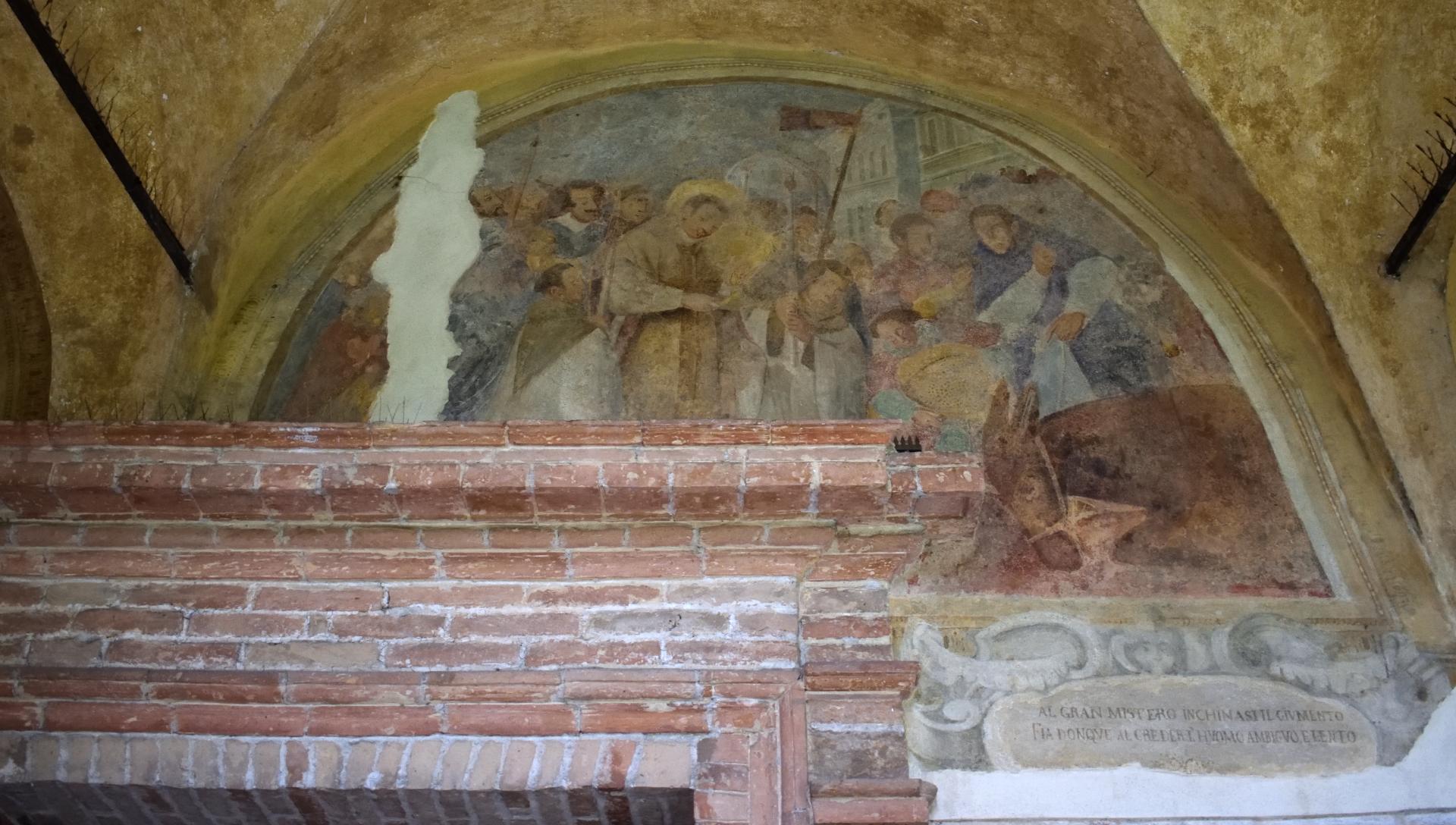
A destra della lunetta una mula, benché digiuna da tre giorni, rifiuta la biada e si inchina dinnanzi all’Eucarestia mostratale da un sacerdote.
Così il Santo riesce a far abiurare un eretico e a convincerlo della presenza di Cristo nel pane della Comunione.
«AL GRAN MISTERO INCHINASI IL GIUMENTO / FIA DUNQUE AL CREDER L’HUOMO AMBIGUO E LENTO»
On the right of the lunette a mule, although fasting for three days, refuses the corn and kneels before the Eucharist shown by a priest. Thus the Saint managed to make a heretic recant and to convince him of the presence of Christ in the Eucharist bread. «AL GRAN MISTERO INCHINASI IL GIUMENTO / FIA DUNQUE AL CREDER L’HUOMO AMBIGUO E LENTO»
12. Miracolo del cibo avvelenato.
Miracle of the poisoned food.
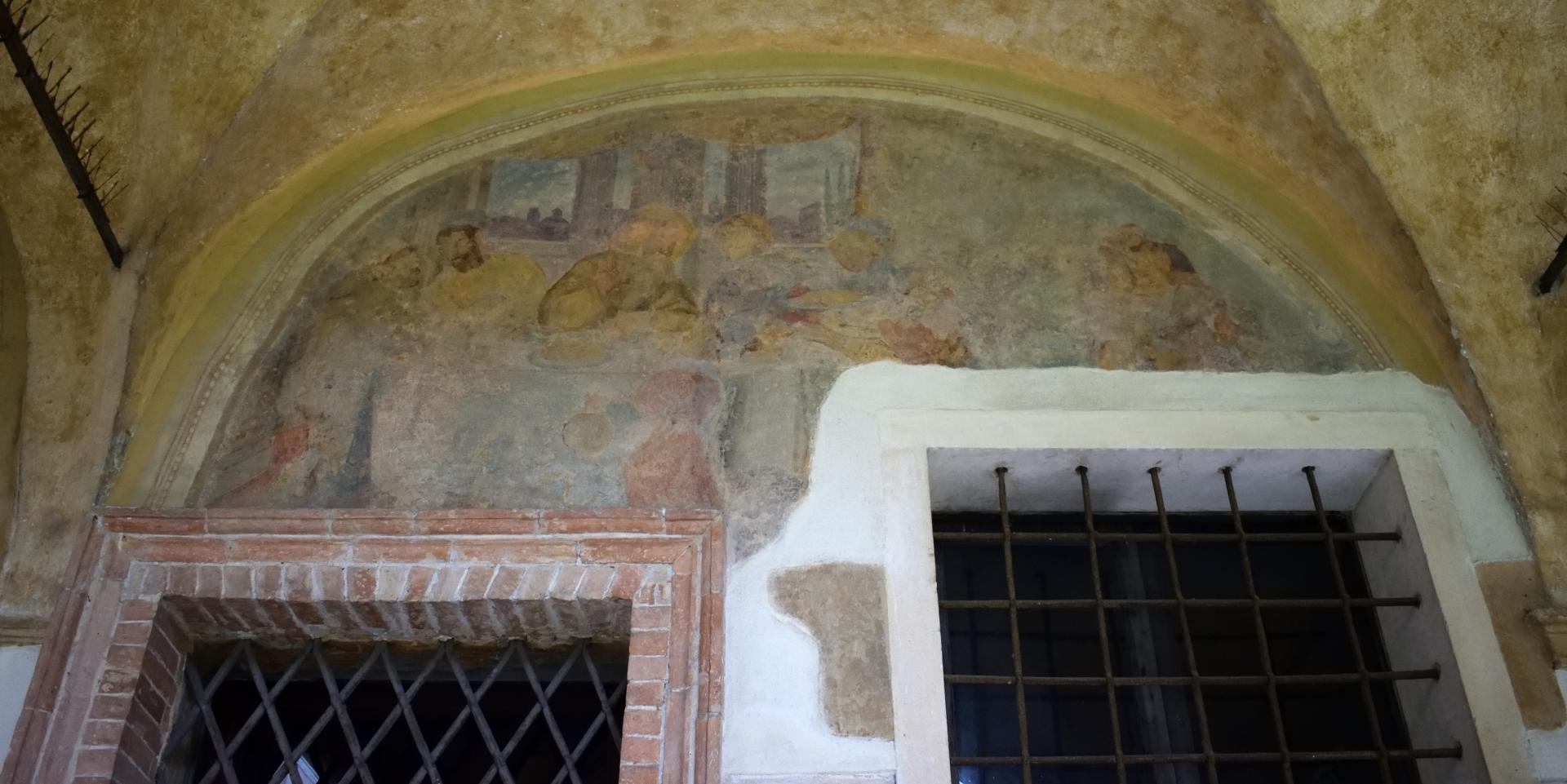
Il cartiglio è andato perduto e l’apertura di una finestra quadrangolare ha frammentato la parte destra della lunetta.
La scena è molto deteriorata, ma si distingue bene il Santo seduto a un banchetto con altri commensali. Gli si offre una pietanza, avvelenata dagli eretici per metterlo alla prova.
Antonio con il dito indica il cielo, e dopo aver pregato si accingerà a mangiarne, rimanendo incolume.
The scroll has been lost and the opening of a rectangular window fragmented the right side of the lunette.
The scene is very deteriorated, but we can easily distinguish the Saint sitting at a banquet with other diners. Anthony is oflered a dish, poisoned by heretics to tempt him.
With his finger, he is poiting at the sky. After praying, he will eat it.
13. Le prediche di Quaresima.
The Lent sermons.
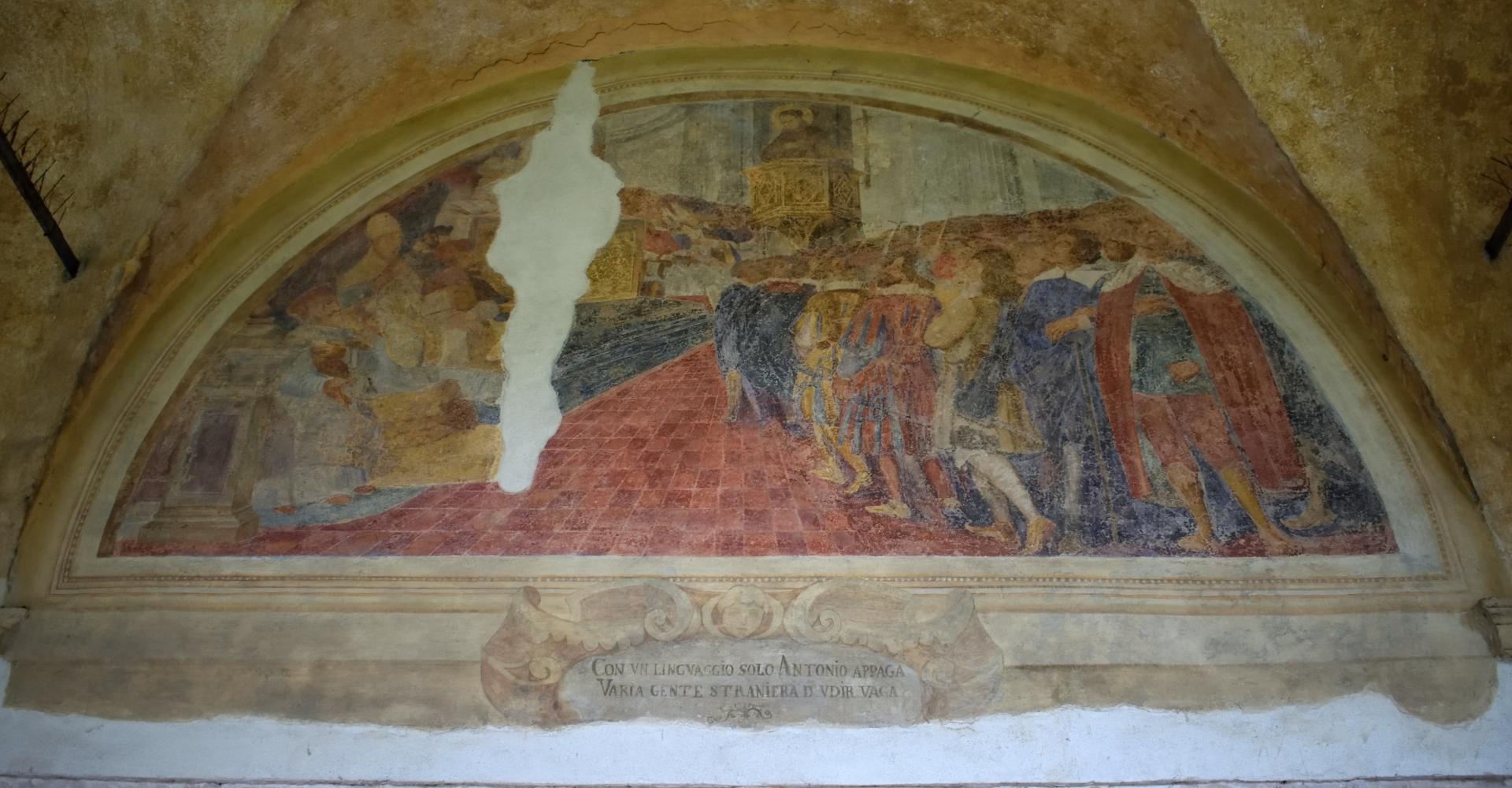
Il cartiglio aiuta a comprendere che Antonio, chiamato da papa Gregorio IX a tenere una serie di sermoni quaresimali, parla a una moltitudine multiculturale in una sola lingua, ma ciascuno lo ode predicare nella propria: «CON UN LINGUAGGIO SOLO ANTONIO APPAGA / VARIA GENTE STRANIERA D’UDIR VAGA».
(anno 1231)
The scroll helps to understand that Anthony, called by Pope Gregory IX to hold some sermons for Lent, spoke to a multicultural crowd in his idiom, but everyone heard him preach in their own language: «CON UN LINGUAGGIO SOLO ANTONIO APPAGA / VARIA GENTE STRANIERA D’UDIR VAGA»
14. Apparizione della Madonna con Bambino al Santo.
Apparition of the Madonna and Child.
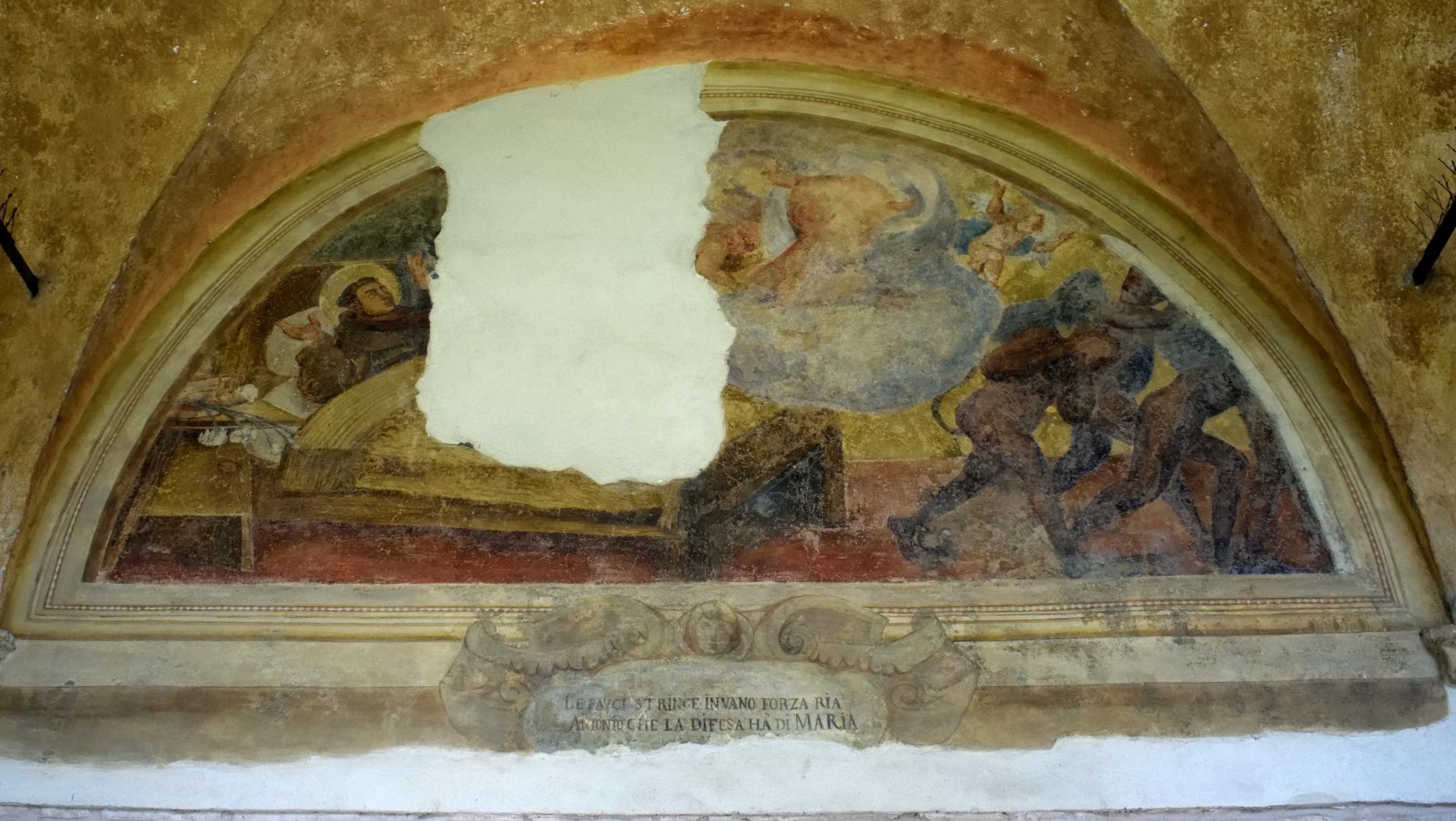
La visione di Maria salva Antonio dal demonio che, prima di riuscire a strangolarlo, è messo in fuga sulla destra del dipinto. «LE FAUCI STRINGE INVANO FORZA RIA / ANTONIO CHE LA DIFESA HA DI MARIA».
The vision of Mary saves Anthony from the devil, who before succeding in strangling him is about to escape on the right‐hand side, as stated in the inscription: «LE FAUCI STRINGE INVANO FORZA RIA / ANTONIO CHE LA DIFESA HA DI MARIA”.
15. Visione di Cristo prima di morire.
Vision of Christ before death.

L’iscrizione dice: «L’ETERNO DIO RIVELA AL SANTO, E SCOPRE / CH’EI TOSTO IL PREMIO AVUTO PER LE SANTE OPRE». Mentre in secondo piano a destra i confratelli assistono Antonio nel letto di morte, sulla sinistra egli è in preda alla visione di Gesù.
The inscription says: «L’ETERNO DIO RIVELA AL SANTO, E SCOPRE / CH’EI TOSTO IL PREMIO AVUTO PER LE SANTE OPRE».
While in the background, on the right hand side, some brothers are succouring dying Anthony on his bed, on the left he is assisting at a vision of Jesus.
16. Morte di Antonio all’Arcella a Padova.
Death of Anthony in Arcella in Padua.

Nel cartiglio si può leggere: «INNOCENTI E […] LI UN STUOL PROMULGA / D’ANTONIO […] LO DIVULGA».
Pare che l’accento sia da mettere sul gruppo di bambini che, sulla destra del dipinto, annunciano a tutti l’avvenuta morte di Antonio.
Le vite di Antonio sostengono che furono i fanciulli per primi ad annunciare alle genti la morte del Santo.
(13 giugno 1231)
In the scroll we can read: «INNOCENTI E [.] LI UN STUOL PROMULGA / D’ANTONIO [.] LO DIVULGA».
It seems that the emphasis has to be put on the group of children who, on the right of the painting, announce the death of Anthony to everyone.
The lives of Anthony claim that the children were the first to announce the Saint’s death to the people.
17. Corteo funebre.
Funeral Procession.
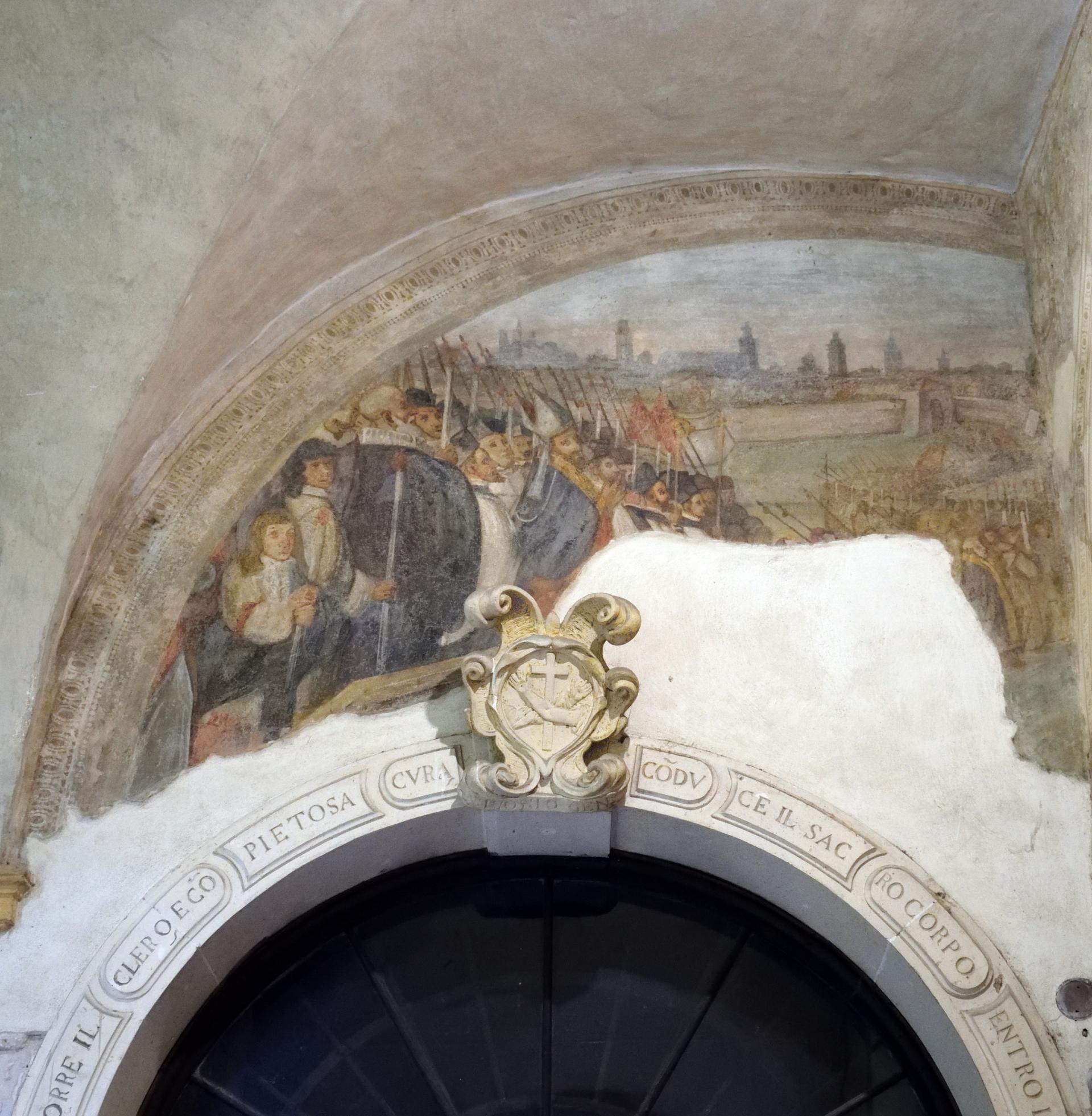
Clero e fedeli accompagnano il Santo dentro Padova, raffigurata sullo sfondo attorniata dalla sue mura. Ne daranno sepoltura presso il convento di Santa Maria Mater Domini.
L’iscrizione che descrive questa lunetta pare essere quella incisa sull’arco del portale sottostante, dove si legge: «CON / CORRE IL / CLERO E CO / PIETOSA CURA / CODU / CE IL SA / CRO / CORPO / ENTRO LE / MURA. AN: 1705: 10 GEN»
La lunetta è lacunosa ed è stata in parte inglobata nella muratura della parete sud occidentale.
The clergy and faithful are accompanying the Saint to Padua, which is depicted in the background surrounded by its walls, to bury him in the convent of Santa Maria Mater Domini.
The inscription that describes this lunette seems to be engraved on the arch of the portal below, and says: «CON / CORRE IL / CLERO E CO / PIETOSA CURA / CODU / CE IL SA / CRO / CORPO / ENTRO LE / MURA. AN: 1705: 10 GEN».
The lunette is incomplete and has been partially incorporated into the South‐western masonry
18. Antonio protegge la città dai nemici.
Anthony protects the city from the enemies.

Il Santo appare in cima a una nube in atto di guardare e proteggere la sottostante città di Padova, mentre una lunga schiera di soldati armati è intenta a entrare dentro le mura.
In analoghi contesti, quest’immagine suole essere riferita alla conquista di Padova da parte di Ezzelino da Romano. In questa lunetta, ciononostante, i soldati portano i vessilli bianco‐rossi e giallo‐neri (e non giallo‐verdi) che possiamo identificare come bandiere dell’imperatore del Sacro Romano Impero, Massimiliano I. Non è da escludere che in questo frangente vi sia cenno agli episodi primo cinquecenteschi della lega di Cambrai.
Il cartiglio è andato perduto.
The Saint appears on top of a cloud looking at and protecting the underlying Padua, while a long line of armed soldiers is entering the walls.
In similar contexts, this image normally refers to the conquest of Padua by Ezzelino da Romano. In this lunette, however, the soldiers are carrying red‐and‐white, and yellow‐and‐black flags (and not the green and yellow ones) that we can identify as the flags of the Holy Roman Emperor, Maximilian I. It is possible that, at this juncture, there is some mention to the episodes of the 16th‐century League of Cambrai.
The scroll has been lost.
19. Risuscitazione di Parrasio.
Resuscitation of Parrhasius.
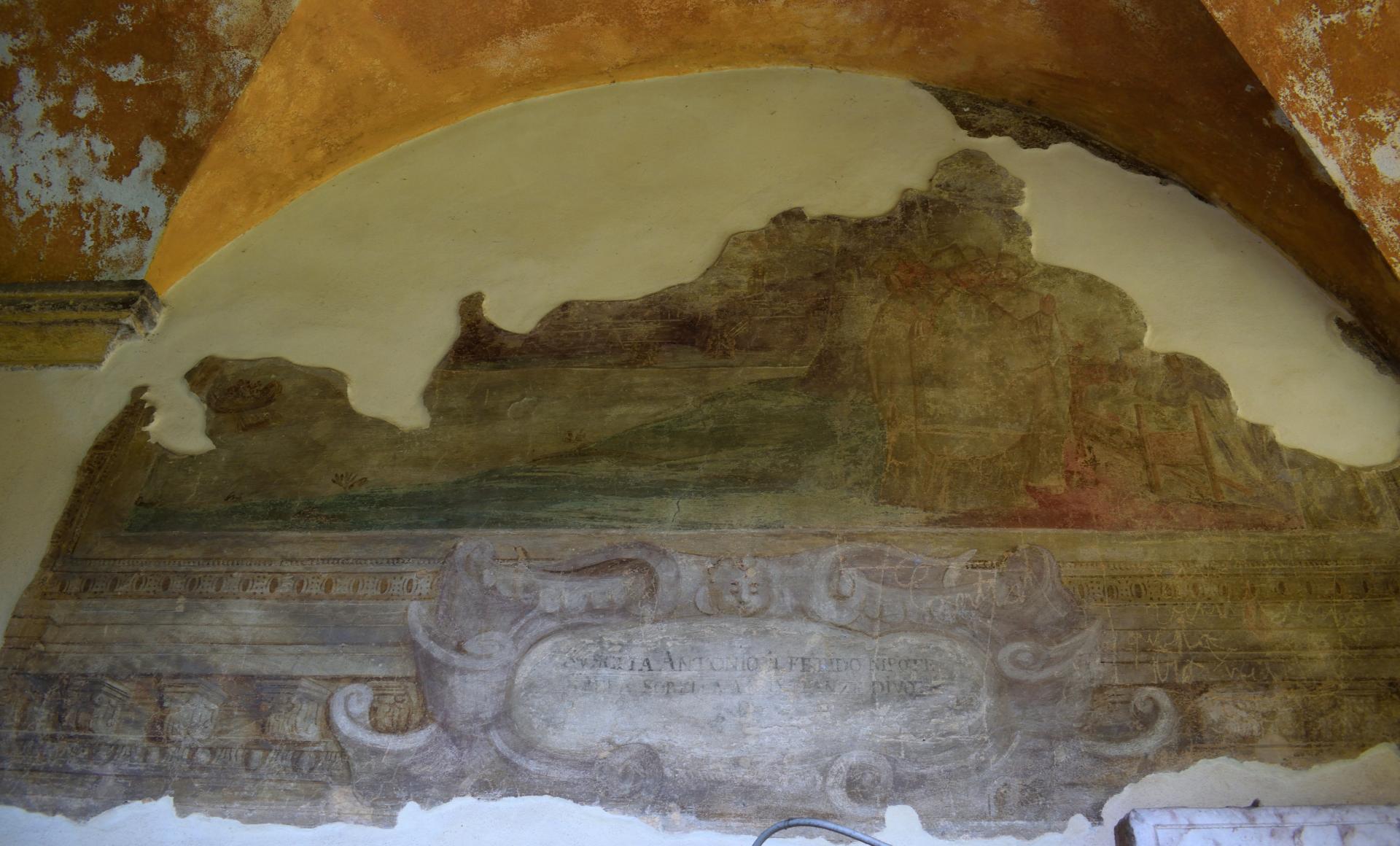
La spiega è lacunosa: «[…] IA ANTONIO IL FERITO NIPOTE / […] SORELLA […]ANZE DIVOTE».
Parrasio, il figlio di cinque anni della sorella di Antonio, giocando in mare con i coetanei, cadde in acqua e annegò. Racconta la Benignitas che la madre chiese l’aiuto di Antonio per salvarlo, promettendo il figlio all’ordine francescano.
E così fu, come descrive la lunetta che, pur avendo grandi mancanze, mostra ancora a destra il piccolo letto del nipote di Antonio e un concorso di familiari attorno.
The scroll is incomplete: «[…] IA ANTONIO IL FERITO NIPOTE / […] SORELLA […]ANZE DIVOTE».
Parrhasius, the 5‐year‐old son of Anthony’s sister, fell into the water and drowned while playing in the sea with some friends. The Benignitas narrates that Anthony’s sister asked for his help to save him, and promised his son to the Franciscan order.
So it was, as told by the lunette that, despite having large gaps, it still shows on the right‐hand side the small bed of Anthony’s nephew and a group of relatives.
20. Il miracolo dei dieci fanciulli annegati.
The miracle of the resuscitation of ten drowned children.
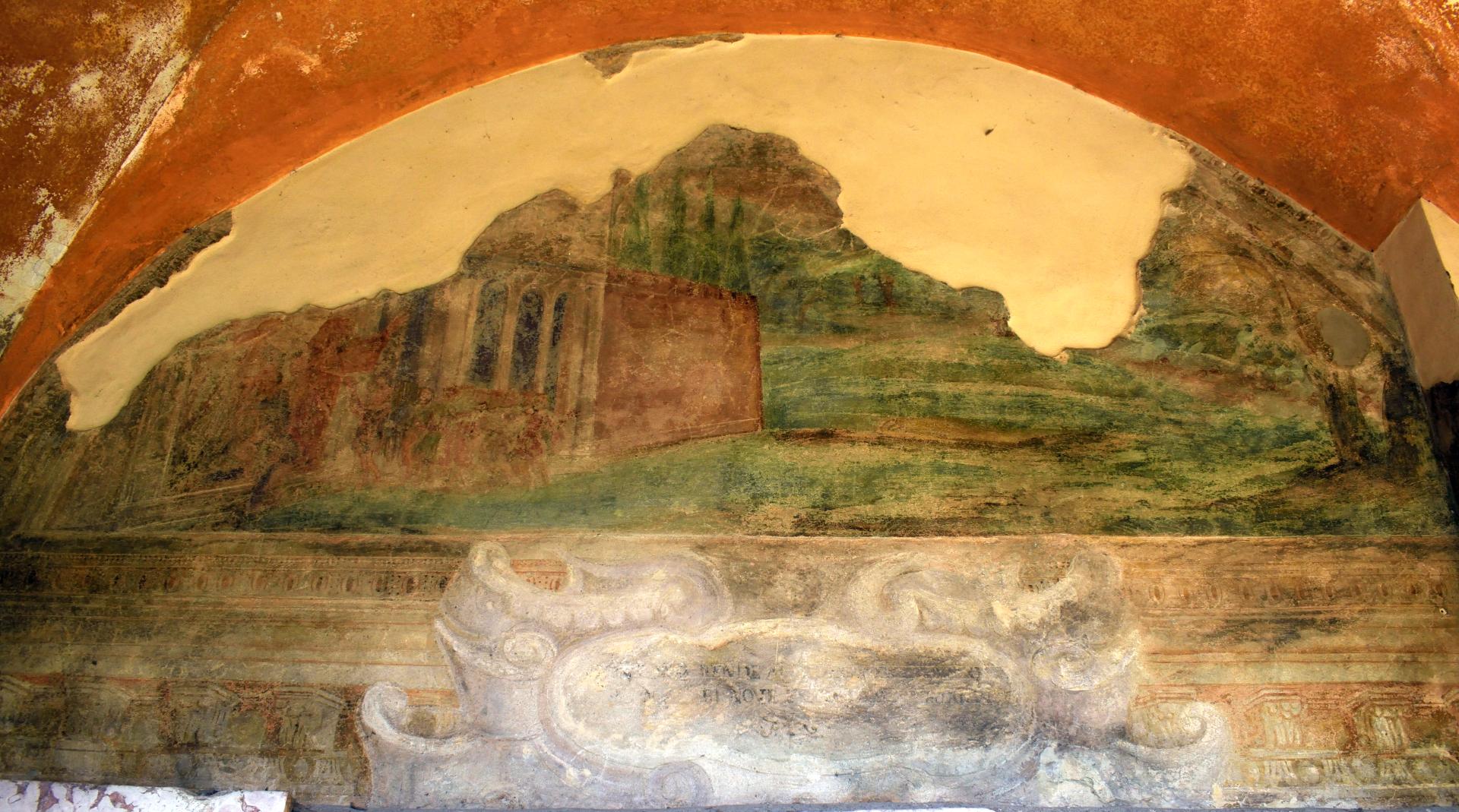
La scena è molto rovinata. Si nota sulla sinistra il Santo all’ingresso di un edificio che riceve un gruppo di bambini. Lo sfondo buio suggerisce una tempesta, così come il vento che piega gli alberi. Intorno all’edificio si vede un’inondazione. Il cartiglio è molto abraso: «[…] RENDE […]/[…]NOVE […]». Pare dover qui identificare il miracolo della risuscitazione di dieci fanciulli annegati.
We can see, on the left‐hand side, the Saint at the entrance of a building while receiving a group of children. The dark background suggests a storm, so does the wind bending the trees. Around the building, we can see a flood. The cartouche is very abraded: «[…] RENDE […] / […]NOVE […]». Apparently here we should identify the miracle of resuscitation of the ten children drowned.
21. Lunetta completamente perduta,
This lunette was completely lost,
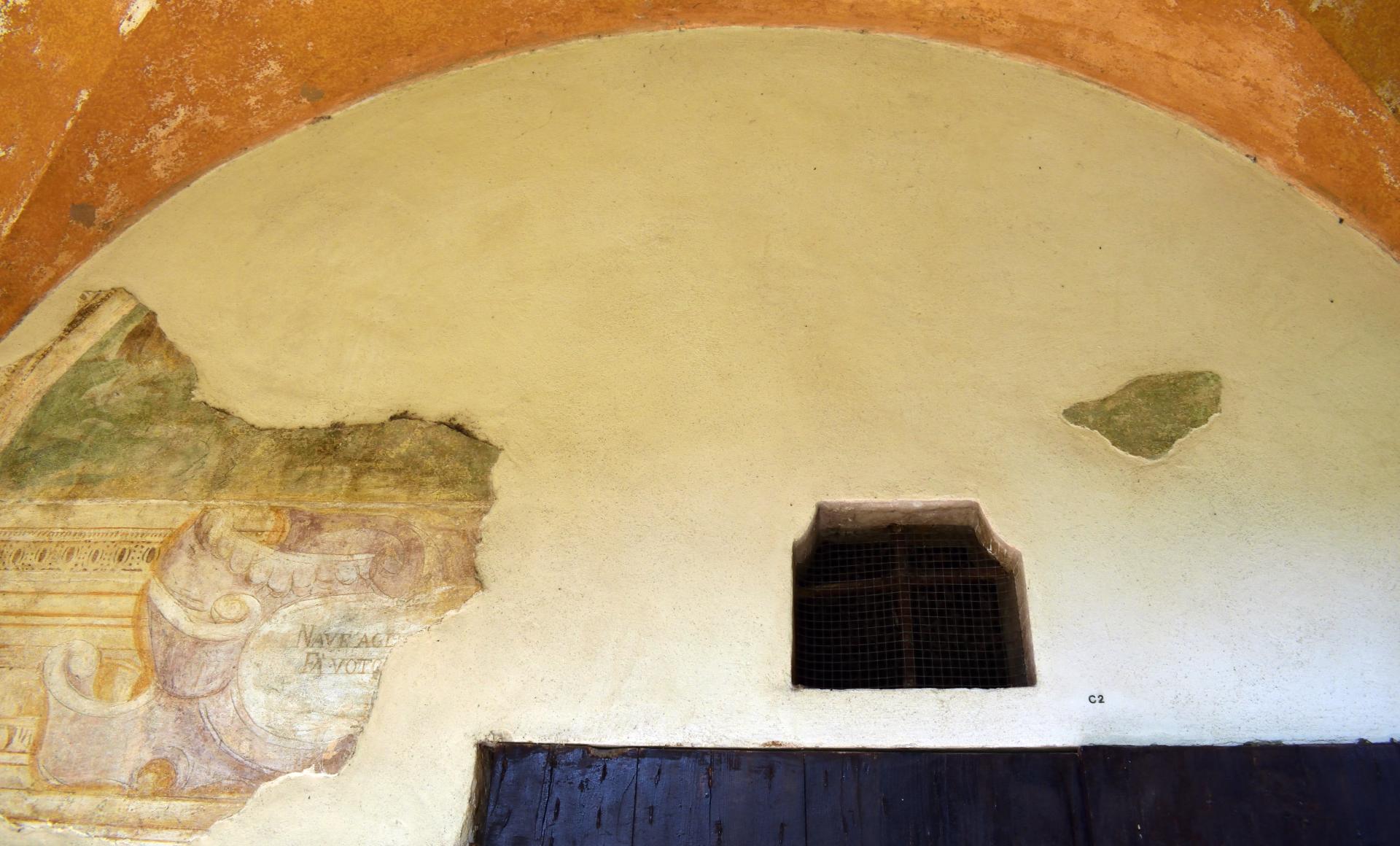
21. Lunetta completamente perduta,
solo nel cartiglio si legge: «NAVE AGL (…) / FA VOTO (…)». Forse si tratta ancora di un soccorso ai naviganti.
only in the scroll records: «NAVE AGL[…] / FA VOTO […]». Perhaps it deals again with assistance to some sailors during the storms.
22. Scena totalmente venuta a mancare.
Scene is missing completely.
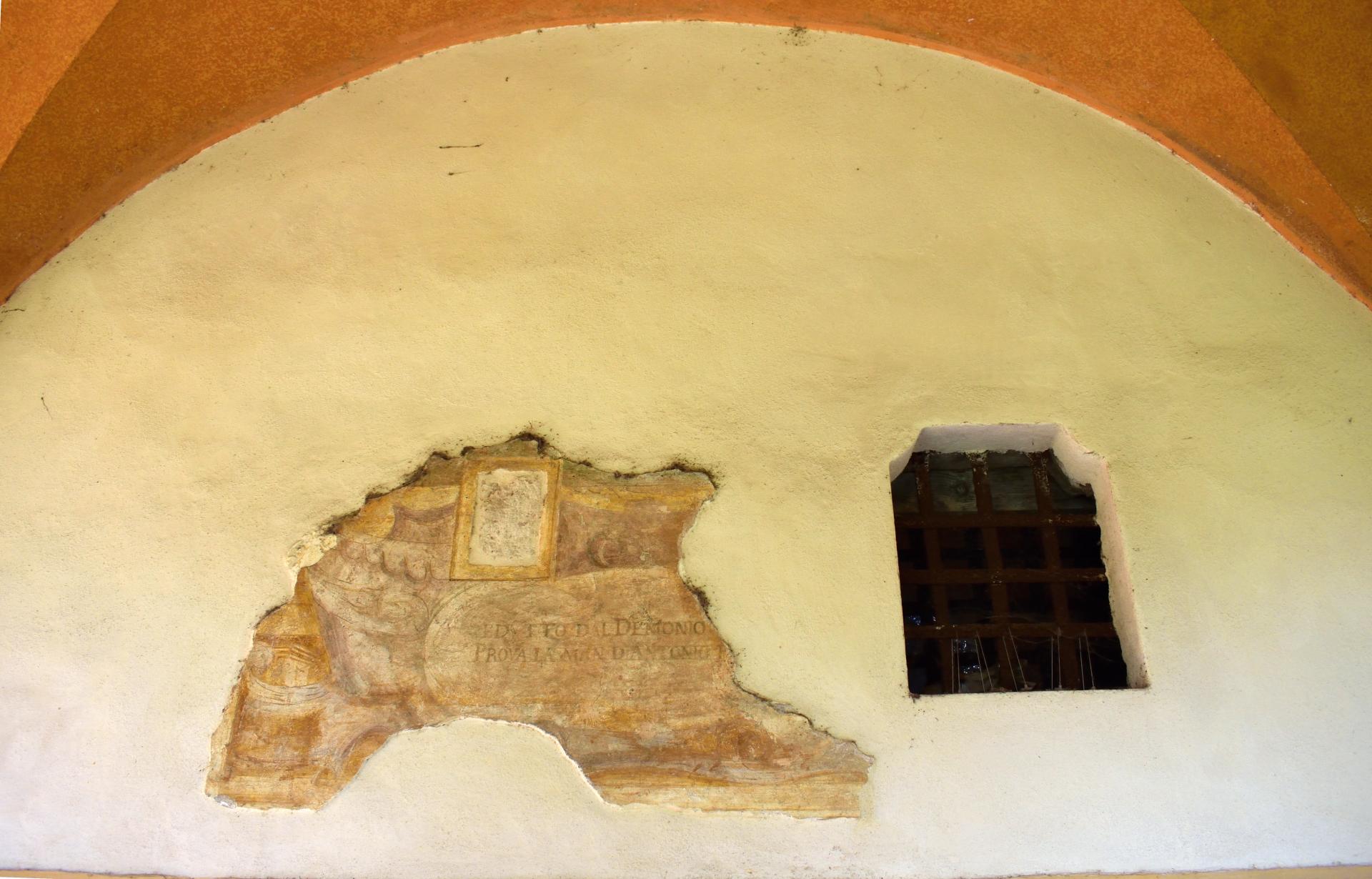
Nel cartiglio si legge: «(…) DETTO DAL DEMONIO / PROVA A MAN DI ANTONIO».
The scroll says: «[…] DETTO DAL DEMONIO / PROVA A MAN DI ANTONIO».
23. Il miracolo dell’amministratore onesto.
The Miracle of the honest administrator.

Alla morte di un usuraio, il suo amministratore finisce in carcere senza riuscire a dimostrare le somme gestite con ricevute appropriate.
Antonio lo porta fuori dal carcere di notte e con una barca (sulla sinistra nel dipinto) lo conduce agli inferi (a destra) per farsi lasciare la ricevuta dal padrone.
Nel doppio cartiglio: «ANTONIO FU CHIUD […] / A FAR LA CARITÀ» e «MORTO FOSSE / DEL SALDATO».
On the death of a usurer, his administrator ends up in jail for failing to prove the amounts received during his work with appropriate receipts.
Anthony takes him out of jail at night, and by boat (on the left) leads him to the underworld (on the right) to meet his boss and get a receipt.
In the double cartouche, «ANTONIO FU CHIUD […] / A FAR LA CARITÀ» and «MORTO FOSSE / DEL SALDATO»
24. Soggetto non identificato,
This subject is not decipherable,
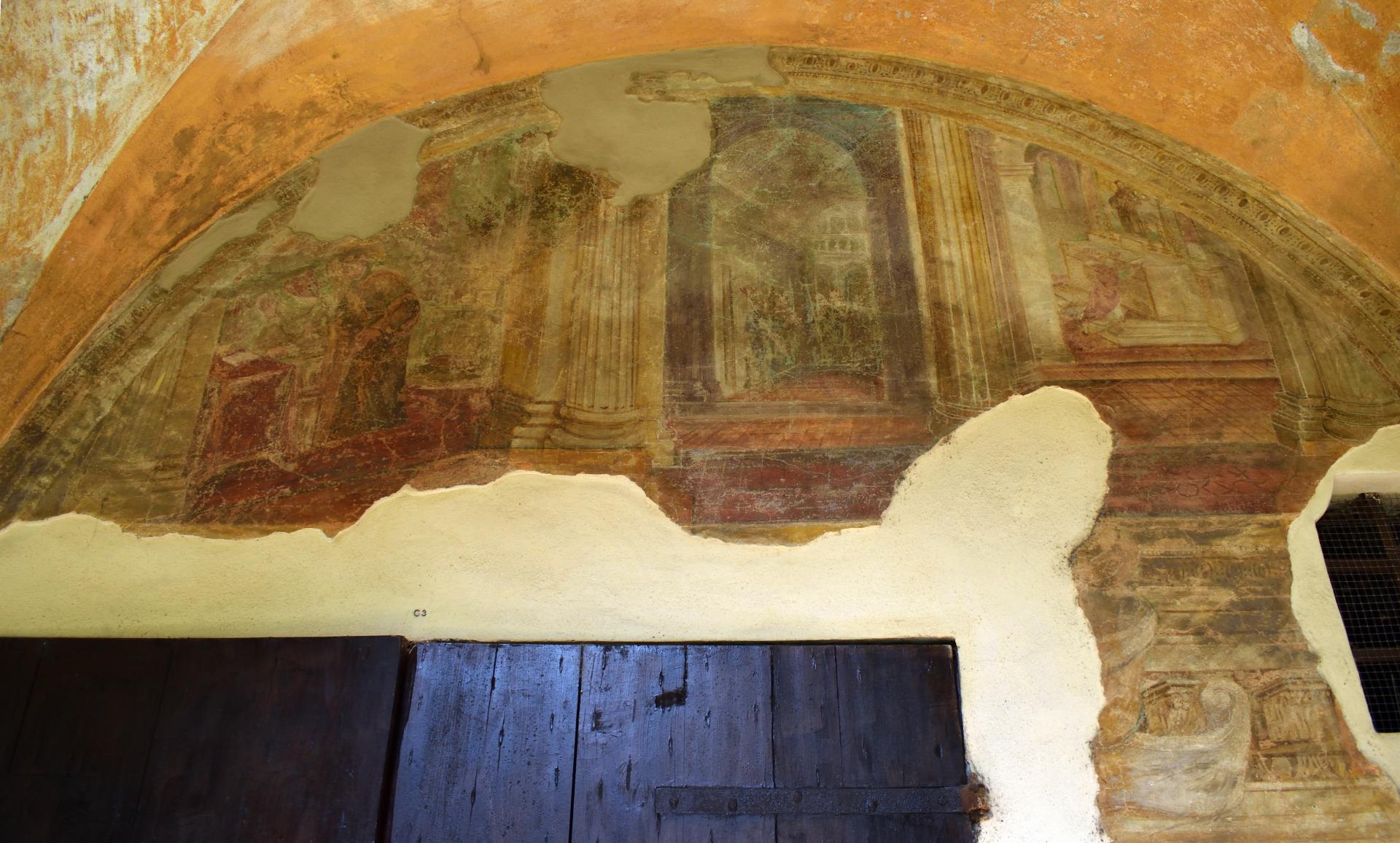
manca anche il cartiglio.
La lunetta è tripartita da una scena prospettica. Nella parte sinistra il Santo appare accanto a una figura orante, a destra si distingue un ecclesiastico in preghiera di fronte all’immagine di Antonio sull’altare.
and also the scroll is missing.
The lunette is divided into three by a perspective scene. On the left side, the Saint appears next to a praying figure, on the right a churchman praying before Anthony’s altarpiece.
25. Il miracolo della donna onesta.
The Miracle of the honest woman.
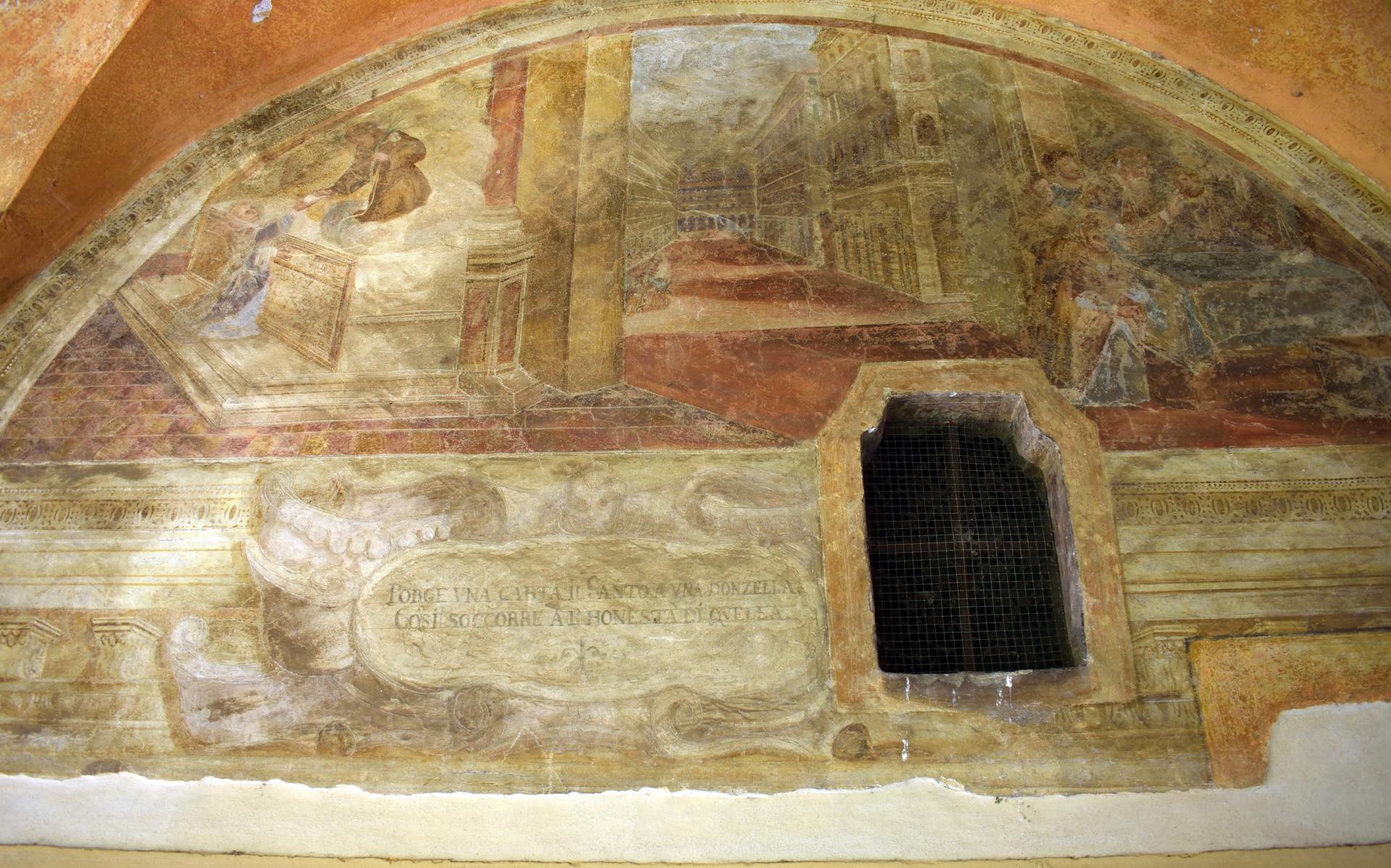
«PORGE UNA CARTA IL SANTO A UNA DONZELLA / COSI’ SOCCORRE A L’HONESTA’ DI QUELLA».
Una donna a Napoli, non avendo più di che vivere, pensa alla strada della prostituzione.
Un giorno Antonio le appare durante la preghiera – a sinistra nella lunetta ‐ e le consegna una lettera con un messaggio indirizzato a un mercante. Con quella carta firmata da Antonio, la donna avrebbe riscosso molto denaro e preservato la sua moralità.
Sulla destra della pittura il mercante pesa la carta con una bilancia e consegna il denaro alla donna.
«PORGE UNA CARTA IL SANTO A UNA DONZELLA / COSI’ SOCCORRE A L’HONESTA’ DI QUELLA».
A woman in Naples, not having enough to live on, thought about prostitution.
One day, while she was praying, Anthony appeared to her – on the left‐hand side on the lunette ‐ and handed her a letter with a message addressed to a merchant. With that letter signed by Anthony, the woman received a lot of money and kept her morality.
On the painting, on the right‐hand side, a merchant is weighing the message with scales and delivering the money to the woman.
26. Il miracolo dell’anello ritrovato.
The Miracle of the lost ring.
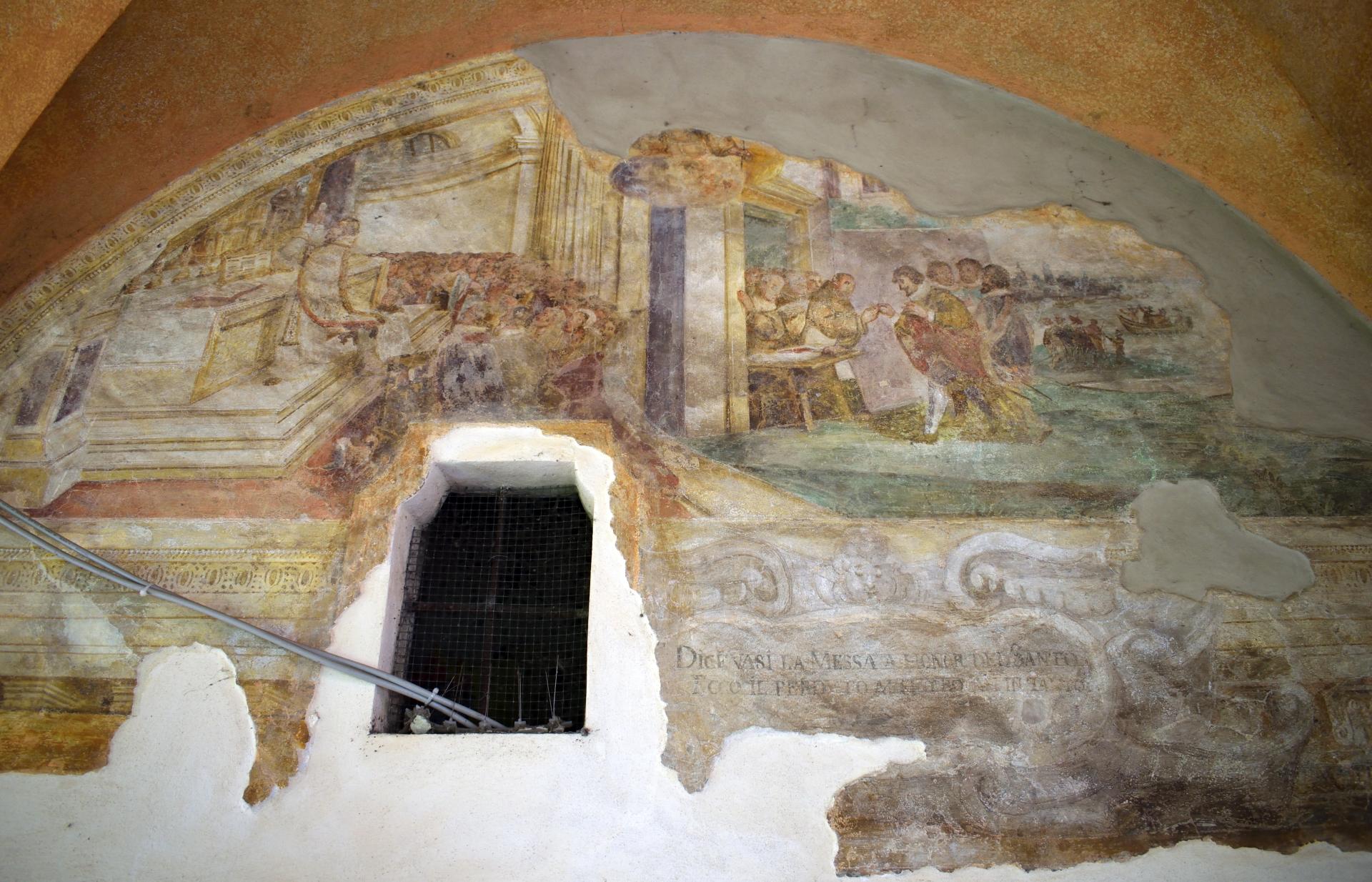
«DICEVASI LA MESSA A HONOR DEL SANTO / ECCO IL PERDUTO […] IN TANTO».
Questo miracolo è relazionato alla capacità di Antonio di far ricomparire gli oggetti smarriti.
Il mercante Niccolò Alfonso perde un anello in un fiume. Dopo aver dedicato una messa ad Antonio per ritrovarlo, e dopo aver offerto del pesce ai confratelli, sulla destra del dipinto si nota come un frate abbia rinvenuto il prezioso dentro a un pesce e lo stia riconsegnando al proprietario.
«DICEVASI LA MESSA A HONOR DEL SANTO / ECCO IL PERDUTO […] IN TANTO».
This miracle is related to the ability of Anthony to make lost things reappear.
The merchant Niccolò Alfonso had lost a ring in a river. After a Mass dedicated to Anthony in order to find it again, and after oflering some fish to the brothers, on the right‐hand side of the painting we can realize that a friar found the precious object inside a fish and gave it back to the owner.
27. Scena interamente perduta.
This scene has been lost entirely.
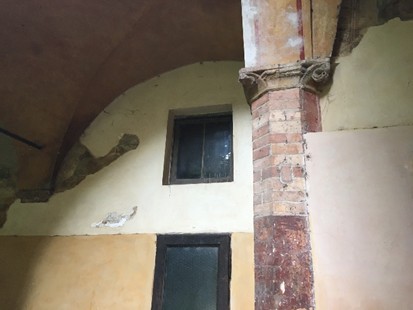
28. La Vergine Immacolata adorata da Antonio e Francesco.
The Immaculate Virgin adored by Anthony and Francis.
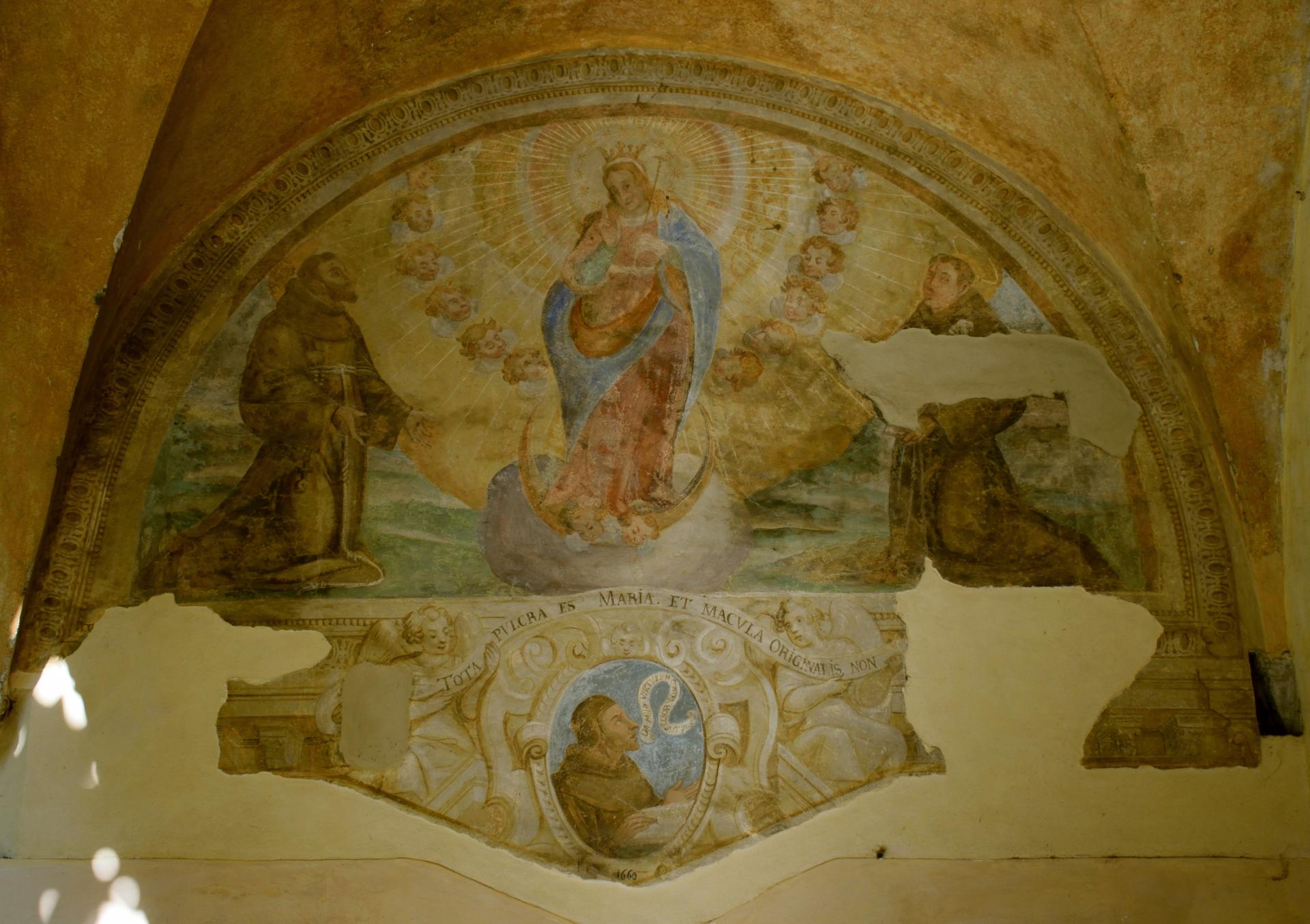
Maria, irradiata di luce e attorniata da angeli, appare sollevata dalla mezza luna mentre mostra una spada come simbolo di vittoria. A sinistra è inginocchiato Francesco e a destra si riconosce Antonio con il suo caratteristico giglio.
Nel cartiglio si legge: «Tota pulcra es Maria et Macula originalis non…».
Più sotto, all’interno di un ovale, è ritratto Giovanni Duns Scoto nell’atto di difendere l’Immacolata Concezione dicendo: «Da mihi virtutem contra hostes tuos».
Si nota in questa lunetta l’iscrizione riferita all’esecuzione degli affreschi: 1660.
Mary, irradiated with light and surrounded by angels, is raised by a half moon and shows a sword as a symbol of victory. On the left Francis is kneeling, and so is Anthony with his distinctive lily on the right.
The scroll says: «TOTA PULCRA ES MARIA ET MACULA ORIGINALIS NON […]».
Below in an oval shape is the picture of John Scotus, who defends the Immaculate Conception by saying, «DA MIHI VIRTUTEM CONTRA HOSTES TUOS».
Here the nscription with the date of the frescoes appears : 1660.
Fonti
I testi di questa pagina sono stati tratti da:
- Il complesso di San Francesco Grande in Padova : storia e arte / Claudio Bellinati … [et al.] ; a cura dell’Associazione culturale francescana di Padova. 1983, Padova.
- I francescani nel veneto / presentazione di Carlo Bernini; prefazione di Alberto Vecchi, 1982 Vicenza.
- ARCHIVIO GENERALE DEL COMUNE DI PADOVA , Atti amministrativi per categorie, b. 884, reg. n. 392, prot. 15324/1929, intestatario Prebenda Parrocchiale di S. Francesco, Richiesta di autorizzazione a eseguire lavori sul lato sud-est del Chiostro, 18 giugn0 1929.
L’immagine della lunetta 7 è tratta dalla pubblicazione La didattica del Restauro 2 – Gli interventi a Padova dell’Istituto Veneto per i Beni Culturali, ente che ha realizzato il restauro delle lunette tra il 2004 e il 2010.
Sources
The text on this page is taken from:
- The Complex of San Francesco Grande in Padua: History and Art / Claudio Bellinati … [et al.]; edited by the Franciscan Cultural Association of Padua. 1983, Padua.
- The Franciscans in the Veneto / Introduction by Carlo Bernini; preface by Alberto Vecchi, 1982, Vicenza.
- GENERAL ARCHIVES OF THE MUNICIPALITY OF PADUA, Administrative Records by Category, b. 884, reg. no. 392, prot. 15324/1929, Parish Prebend of San Francesco, Request for Authorization to Carry Out Work on the Southeast Side of the Cloister, June 18, 1929.
The image of lunette 7 is taken from the publication Restoration Teaching 2 – Interventions in Padua by the Istituto Veneto per i Beni Culturali, the institution that carried out the restoration of the lunettes between 2004 and 2010.
